
The system
One system. Designed around your home.
We don't sell off-the-shelf packages. Every FireShield installation is designed around your property — its roof, its garden, its water supply and how often you're there — after a free site survey, and priced with a fixed written quote.
Book a free surveyDesigned around you
What your system can include.
These are the building blocks we combine around your property. The survey decides which your home needs — nothing more, nothing less.
Around the house
A buried spray line wets walls, windows, planting and the ground beside them — the first barrier a ground fire meets.
Roof, ridges and terraces
Sprinklers along the roof ridge and edges, plus the valleys and terraces where embers settle — the surfaces homes actually ignite from.
Its own water and power
A reserve tank, independent pump, biodegradable foam and battery or generator backup — the system keeps running when the mains and the grid don't.
Automatic activation and monitoring
On-site detection switches the system on by itself when fire approaches, even when nobody is home — with app control and 24/7 monitored oversight.
Site survey and design
A specialist walks the plot, measures roof geometry, vegetation load and prevailing summer winds, then models nozzle placement and the water volume needed to hold the property wet for the duration of an ember storm.
Installation
Lines are buried, nozzles are fitted at ridge, eave and boundary points in a finish chosen to disappear into the architecture. The pump house, tank and control cabinet are placed away from the fire face.
Continuous monitoring
Your property sits inside a geofence. Satellite hotspot feeds, local emergency services data and wind modelling are polled around the clock through the fire season.
Activation
When a fire front approaches the recommended perimeter, you receive a live alert with our guidance on when to activate. Turn the system on at the wall cabinet — or choose automatic activation and it switches on by itself, even when nobody is home.
Saturation and hold
Water and biodegradable firefighting foam coat roof, façade, terraces and the vegetation belt. Foam clings and holds moisture far longer than water alone, denying embers anything dry to ignite.
Service and readiness
Pre-season testing, nozzle flushing, pump servicing, foam replenishment and a documented readiness report you can hand to your insurer.
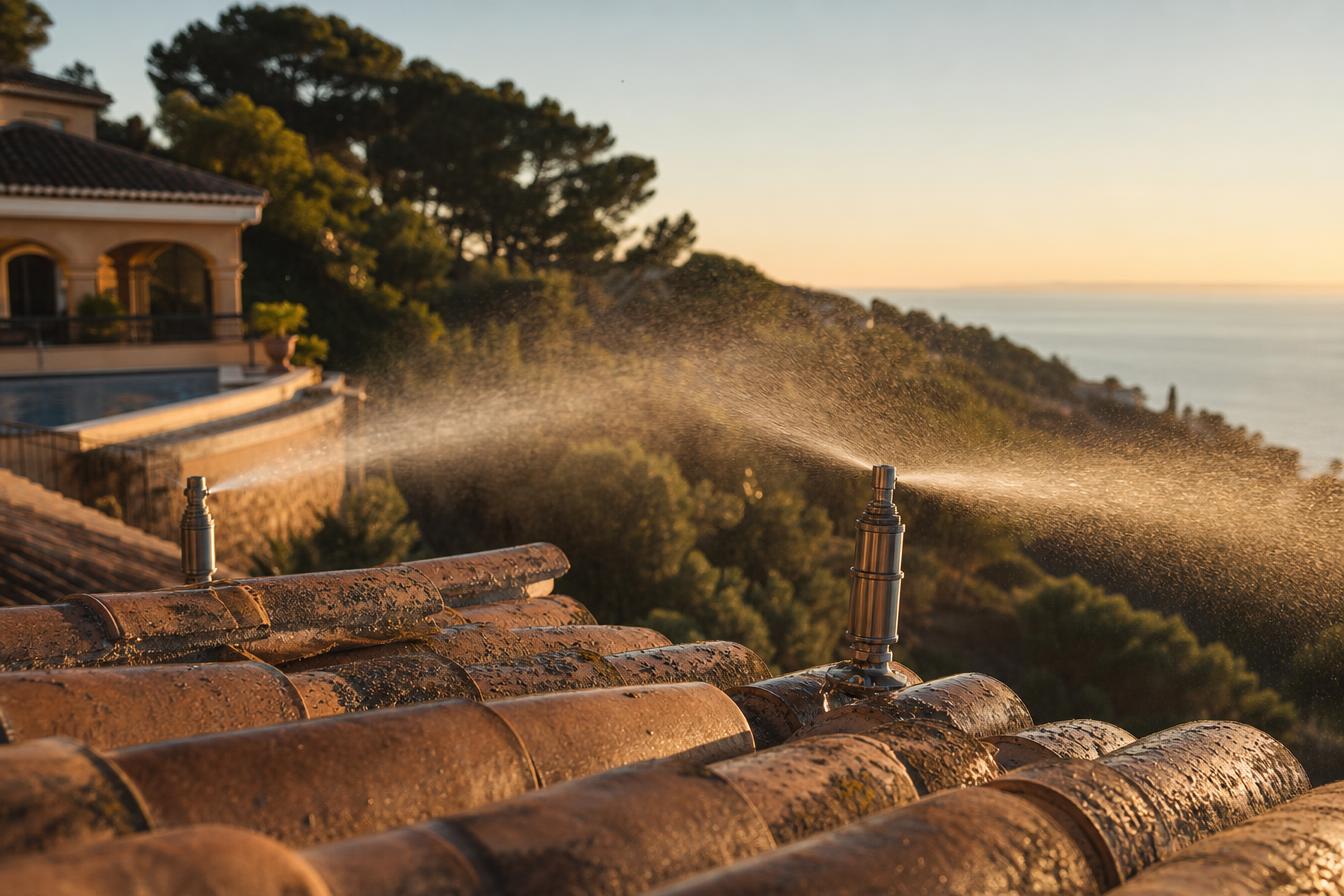
Built for hard climates
Salt air, hard water, dry and windy forty-degree summers.
Coastal heat and arid hillsides punish equipment everywhere we install. We specify marine-grade stainless, UV-stable buried polyethylene and scale-tolerant pump assemblies, then test the whole system before every fire season so nothing is discovered on the day it is needed.
Book a free surveyHardware
Powerful when needed. Discreet every day.
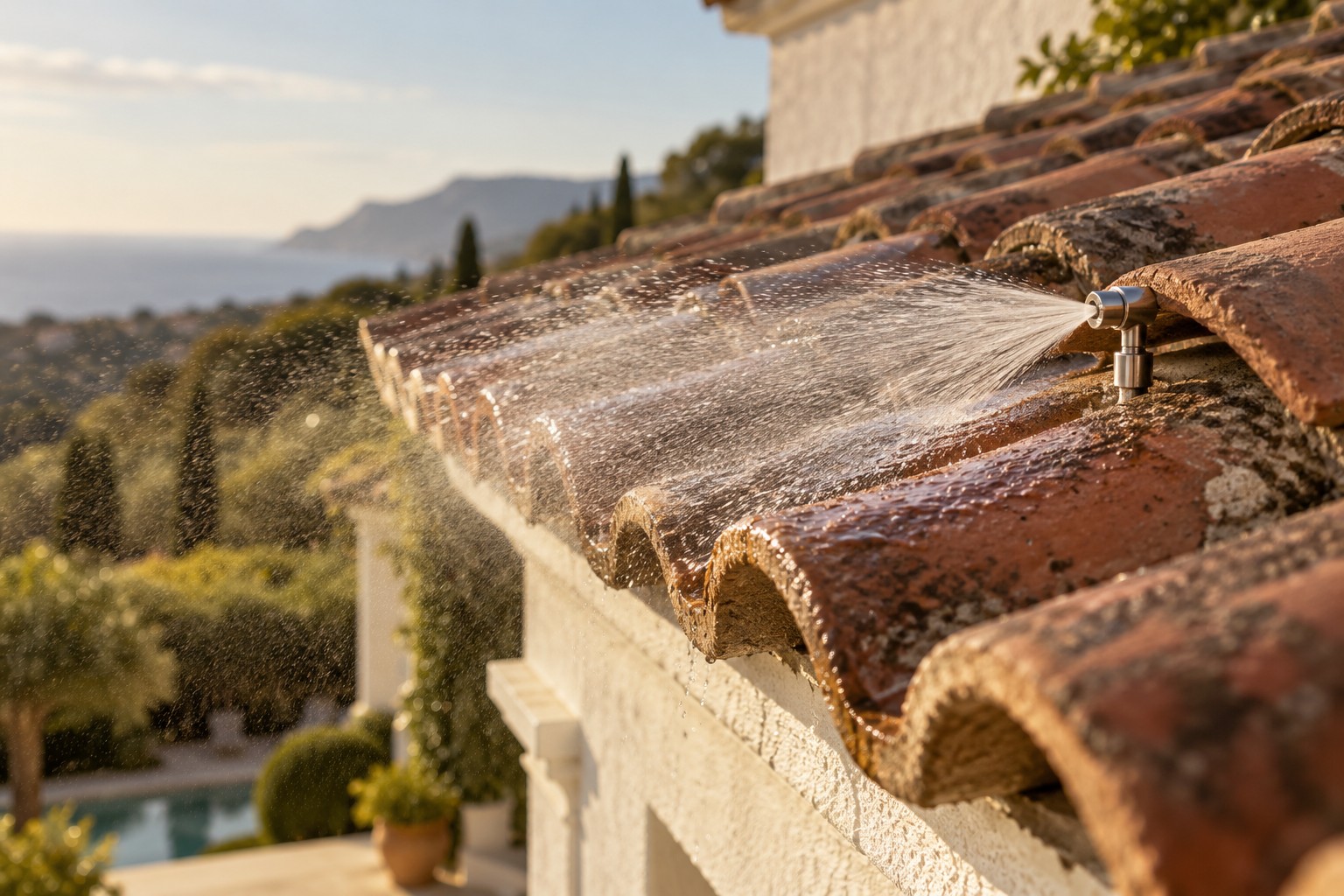
Low-profile nozzles protect the roof and garden while buried pipes stay out of sight. Your system can add its own pump, water reserve and backup power.
- Marine-grade stainless-steel nozzles
- Buried, weather-resistant water lines
- Water and backup power options
- Biodegradable firefighting foam
Every system is planned for the shape, water supply and risk profile of your property.
- AISI 316
- Marine-grade stainless
- IP66
- Sealed control cabinet
- Annual
- Certified readiness test
7 km
Recommended distance for activating protection
24/7
Live wildfire information, wherever you are
Insurance
A fire-safe home is becoming an insurable home.
Across southern Europe, wildfire losses are re-shaping the property market from the inside out. Insurers are re-rating high-risk postcodes, raising excesses, narrowing wildfire wording and, in the worst-exposed hillside zones, declining to quote at all. Mitigation is moving from a nice-to-have to the thing an underwriter asks about first.
We make no promise of a discount — that is your insurer's decision. What we do is give you evidence: a drawn specification, a commissioned wet test, and an annual readiness report your broker can put in front of an underwriter. A defended property with a documented, maintained system is a materially different risk to the one next door.
What you receive for the property file
Drawn system specification
Nozzle layout, hydraulic calculations and coverage zones for your exact plot.
Commissioning wet-test certificate
Documented proof the installed system performed to specification on handover.
Annual readiness report
Pre-season test, pump service and foam check, closed out in writing each year.
Maintenance record
A continuous service history — the evidence underwriters look for at renewal.
FireShield Technology SL is not an insurer or broker and gives no guarantee of cover or premium reduction. Terms are always set by your insurer.
Questions
Before you decide
How does it actually protect my home?
When a wildfire threatens, the system soaks your roof, garden and boundaries with water and biodegradable foam before embers arrive. Embers can travel kilometres ahead of the flames — wetting your property before they land is what stops it igniting.
Do I need to be home for it to work?
That's a design choice we make together at the survey. You can switch the system on yourself at the control cabinet — or, if you're often away, we design it to switch on by itself when fire is detected, with app control and monitored oversight.
Where does the water come from?
For many homes the mains supply is enough. If you have a pool, tank or borehole, we can draw from it — and the system can be designed with its own reserve tank and pump, so it never depends on one source.
What happens if the power goes out?
If your design includes backup power — battery or generator — protection keeps running when the grid is down. We recommend it for exposed properties, and it's one of the things we assess at the survey.
Will I see it on my house?
Barely. The lines are buried and the nozzles are low-profile marine-grade stainless steel — protection you barely notice day to day.
What does it cost?
Every property is different. Roof geometry, plot size, water pressure and terrain change the specification, so your fixed price only becomes meaningful after the free survey, which ends with a written specification and no obligation. Not sure what your home needs? The six-question guide on the booking page gives you a first idea.
Can it be extended later?
Yes. Every system is built on the same pipework, so coverage, water reserves and activation options can be extended later without replacing what is already installed.
Will this reduce my insurance premium?
We cannot promise a discount — that is the insurer's decision, and it varies by company and policy. What we can say is that in high-risk Mediterranean zones the question is increasingly whether cover is offered at all. A documented, professionally installed and annually certified defence system gives your broker something concrete to present, and every installation is handed over with the paperwork to do it.
What happens after installation?
We test and service the system before every fire season, including a certified annual readiness test, so it is ready when it matters.